Dense
Ming-3.0-tts-0.5b
0.5B parameters, for lightweight deployment.
- Backbone
- Qwen2.5-0.5B
- Tasks
- Every task except podcast
Inclusion AI · Ant Group
Open-weights speech generation for audio stories, short-video narration and product assistants. Voice design, cloning, director-style instructions, paralinguistic tags, seven languages and two dialects.
01Architecture
Text and task-specific control tokens condition a language model with a DiT patch head and an audio tokenizer. Capabilities use separate task modes, not arbitrary combinations.
02Voice design
Audio stories, short-video narration and product assistants each need their own voice. Voice Design creates one from a text description; with a reference clip at hand, the model clones that voice instead.
03Director mode
Tell the model in plain language how a line should be performed: how the emotion shifts, which words to stress, how the rhythm goes. Listen, then adjust the direction or the line.
04Paralinguistic tags
A sigh before a line, or a short laugh halfway through it, tells listeners what state a character is in. Inline tags place the laugh, the sigh or the cough exactly where it belongs.
05Languages and dialects
For international products and audio content, Ming-3.0-tts speaks Chinese, English, Japanese, Korean, French, German and Spanish. Below, one story in all seven, in two cloned voices. Given a reference clip in the same dialect, it also speaks Sichuanese and Cantonese.
06Models
Both models are built for efficient inference. Weigh content length, expressive needs and compute budget when choosing.
Dense
0.5B parameters, for lightweight deployment.
Mixture of experts
7.9B total and 1.3B active parameters, with long-form podcast generation.
07Benchmarks
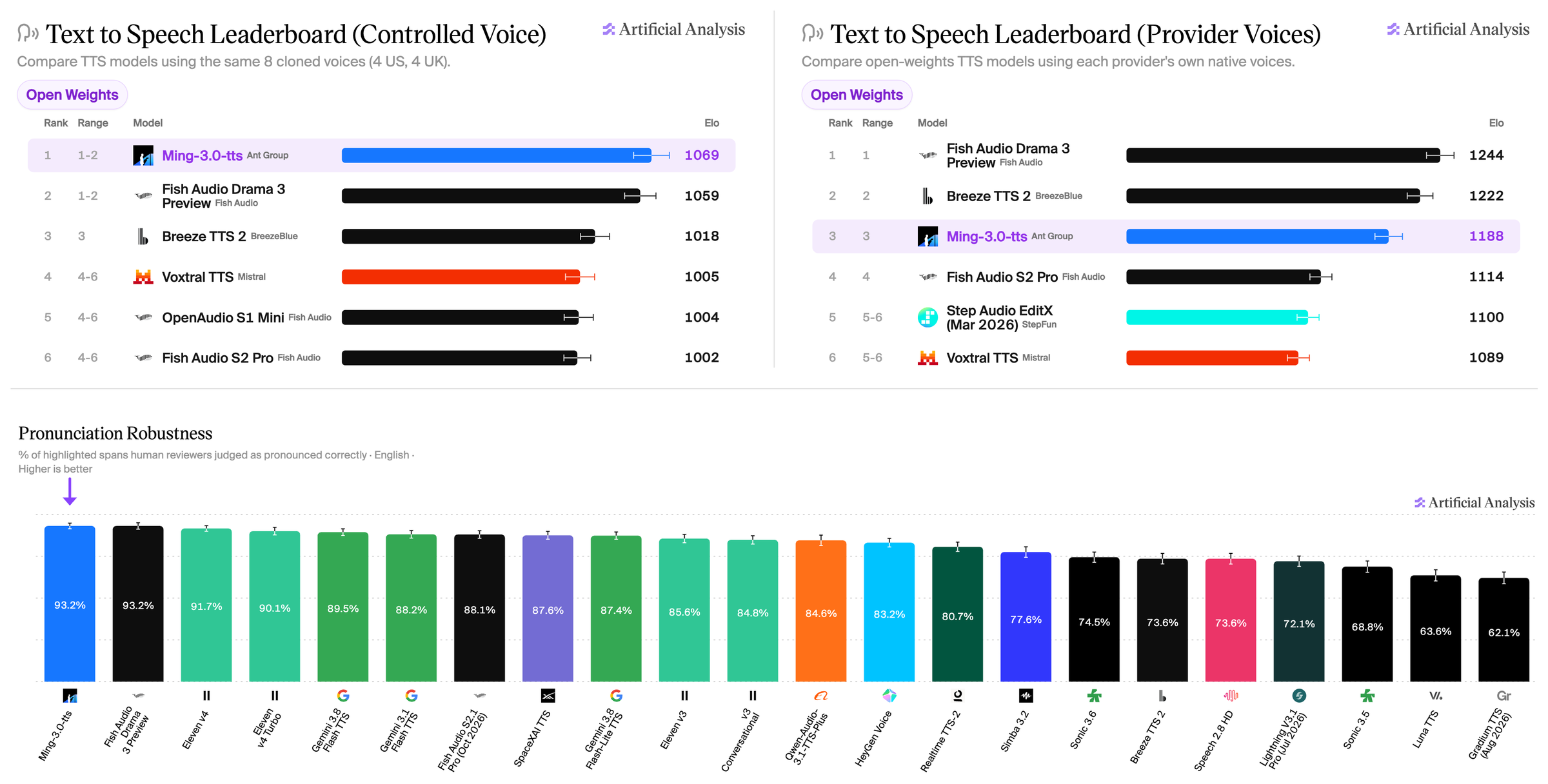
Ming-3.0-tts-0.5b on Artificial Analysis, October 2026 (as captured). Ranks change as new models are added.
Every model clones the same eight English reference voices, so naturalness, audio quality and rhythm are compared under one voice: a basis for choosing a model to dub from a reference. Ming-3.0-tts-0.5b scores 1069 Elo, 1st among open-weights models and 13th overall.
Bars start at Elo 800Artificial Analysis
Whether proper nouns, abbreviations and numbers are read correctly: what English narration and announcements demand of key details. Ming-3.0-tts-0.5b scores 93.2%, tied for 1st, and is 1st on the Expanding Shorthand (96.5%) and Preserving Exact Sequences (90.6%) sub-scores.
Bars start at 0%Artificial Analysis
Each model speaks in its own representative voices, so the comparison is the overall impression in real use: a guide to voice options for product assistants and content dubbing. Ming-3.0-tts-0.5b scores 1188 Elo, 3rd among open-weights models and 17th overall.
Bars start at Elo 800Artificial Analysis
The full evaluation of both models also covers generation in Chinese, English, German and Spanish, paralinguistic control and voice design from text. Check separately whether speech is read correctly, whether the voice matches its description and whether tags trigger the intended sound, then choose the model for your workflow. Full tables are in the repository README.
WER and PCER: lower is better. SIM and ACC: higher is better.
Next: more consistent voices across languages, finer emotion and role control, and steadier paralinguistic and long-form generation.
08Samples
Each one is a single call to one task, with its text and controls as given.
Get started
Installation, inference examples and a cookbook for every task are in the repository.
pip install "huggingface_hub[cli]"
hf download inclusionAI/Ming-3.0-tts-0.5b \
  --local-dir Ming-3.0-tts-0.5b

# In mainland China, ModelScope is usually faster
pip install modelscope
modelscope download --model inclusionAI/Ming-3.0-tts-0.5b \
  --local_dir Ming-3.0-tts-0.5b